
Salesforce FSC Implementation Cost and Timeline for Banks
For a bank considering Salesforce Financial Services Cloud (FSC), two of the first questions are usually straightforward:
How much will the implementation cost, and how long will it take?
There is no single number that applies to every bank. A focused FSC implementation can be completed in a matter of weeks, while a larger transformation involving multiple business units, complex integrations, significant data migration, and extensive customization can take several months.
The biggest mistake is estimating an FSC implementation based primarily on the number of Salesforce users. Implementation effort is usually driven more by scope, data, integrations, processes, and complexity than by license count.
Understanding those factors can help banks create a more realistic implementation plan.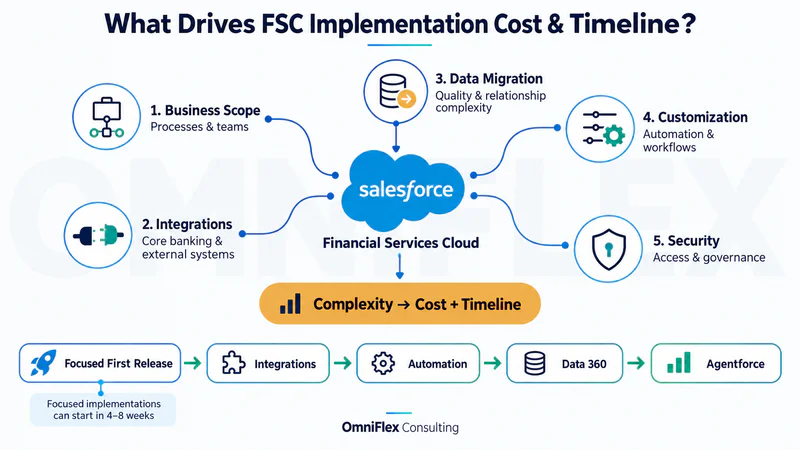
What Drives Salesforce FSC Implementation Cost?
The cost of implementing Financial Services Cloud depends on what the bank expects Salesforce to do.
A focused first release for a commercial banking team may include customer and prospect management, relationship modeling, commercial opportunities, activities, referrals, dashboards, and basic data migration.
That is very different from an enterprise program attempting to implement commercial banking, retail banking, wealth management, service, onboarding, marketing, integrations, Data 360, and Agentforce simultaneously.
Several factors typically have the greatest impact on implementation effort.
1. Business Scope
The first question should be: Which business problem are we solving?
A bank that starts with commercial relationship management can define a relatively focused scope around Relationship Managers and their workflows.
For example, the first release might provide Relationship Managers with a consistent view of customers, related businesses, key contacts, opportunities, activities, referrals, and next steps.
Once additional departments and processes are included, the implementation becomes more complex.
This is why defining a clear first-release outcome is often more important than creating a long list of Salesforce features.
2. Core Banking and Other Integrations
Integration can become one of the largest components of an FSC implementation.
Banks may have information distributed across core banking platforms, loan origination systems, digital banking applications, document systems, marketing platforms, servicing systems, and other applications.
Not all of that information needs to be copied into Salesforce.
A better approach is to determine what information employees actually need and how current that information must be.
Some information may be synchronized on a schedule. Other information may require real-time API access. Broader customer data requirements may eventually justify a Data 360 architecture.
The integration pattern should follow the business requirement rather than assuming every banking system needs a large bidirectional Salesforce integration.
3. Data Migration and Data Quality
Data migration often looks simple during initial planning and becomes more complicated during implementation.
The technical act of importing accounts and contacts is rarely the difficult part.
The harder questions are:
Which records should be migrated?
Are duplicate customers present?
How are businesses and individuals related?
Who owns each relationship?
How should historical activities be handled?
Which source should be considered authoritative?
For a commercial bank, relationship modeling makes these questions particularly important because one customer relationship can include businesses, owners, related companies, financial relationships, and multiple opportunities.
Cleaning and mapping this information can significantly affect both cost and timeline.
4. Customization and Automation
Financial Services Cloud provides financial-services-specific capabilities, but every bank still has its own processes.
Some configuration is expected.
Problems arise when teams attempt to reproduce every legacy process exactly inside Salesforce.
That can lead to excessive custom fields, automation, Apex development, and complicated user experiences that become expensive to maintain.
We generally prefer starting with standard Salesforce and FSC capabilities where they fit the business requirement, then introducing customization when there is a clear reason for it.
The objective should be a useful banking CRM, not a digital recreation of every existing process.
5. Security and Access
Banking implementations require careful security design.
Different employees may require different access to customers, opportunities, financial information, activities, and other records.
Role hierarchy, sharing, permission sets, field-level security, integration users, audit requirements, and sensitive-data handling should therefore be considered early in the architecture.
Trying to redesign the security model immediately before production deployment can add unnecessary risk and delay.
How Long Does an FSC Implementation Take?
There is no universal implementation timeline.
A tightly scoped FSC implementation can potentially be delivered in approximately four to eight weeks when requirements are clear, integrations are limited, and data migration is manageable.
For example, Omniflex completed an initial FSC implementation for a Northeast U.S. commercial bank in approximately six weeks.
That does not mean every bank should expect a six-week implementation.
A broader implementation involving complex core banking integrations, multiple business units, significant migration, extensive automation, or organizational change can require several months.
Instead of asking only, “How quickly can we implement FSC?”, a more useful question is:
“What is the smallest production release that creates meaningful value for our Relationship Managers?”
That changes the implementation conversation considerably.
What Does a Focused FSC Implementation Cost?
Implementation pricing should follow the scope.
For organizations looking for a tightly defined starting point, Omniflex offers focused Salesforce QuickStart engagements beginning around $4,999, depending on requirements.
A broader FSC banking implementation will cost more because the work may include discovery, architecture, FSC configuration, data modeling, migration, integration, security, automation, testing, training, and deployment.
Rather than treating a low starting price as the expected cost of every FSC project, banks should evaluate the specific capabilities required for their first production release.
This creates a more meaningful estimate and reduces surprises later.
Why We Prefer a Phased FSC Implementation
Banks do not need to solve every Salesforce use case in the first release.
A practical roadmap might begin with:
Phase 1: Relationship management and commercial pipeline
Phase 2: Core banking and other priority integrations
Phase 3: Additional workflows, automation, and customer servicing
Phase 4: Data 360 and broader customer intelligence where required
Phase 5: Agentforce use cases built on trusted data and processes
The exact sequence will vary by bank, but the principle is important.
Build the foundation first. Validate adoption. Then expand.
This approach also makes it easier to evaluate whether each additional investment is producing business value.
A Better Way to Plan an FSC Budget
Before asking an implementation partner for a fixed estimate, a bank should be able to answer a few fundamental questions:
Who will use Salesforce first?
Which business processes belong in the first release?
Which systems must integrate with Salesforce?
What data needs to be migrated?
What information does a Relationship Manager need to see?
What can wait until a later phase?
Those answers have a much greater impact on the implementation budget than simply knowing the number of Salesforce users.
The Bottom Line
Salesforce Financial Services Cloud implementations for banks do not need to begin as large transformation programs.
A focused implementation can establish customer relationships, commercial pipeline management, activities, referrals, and the foundation for future integration within a relatively short period.
The key is controlling scope.
Once the foundation is working and employees are using it, the bank can progressively introduce core banking data, automation, Data 360, Agentforce, and additional business processes.
For many community and commercial banks, that phased approach provides a more practical path to FSC than attempting to build the final-state architecture in the first release.
Get Practical Salesforce & AI Agent Insights
Actionable insights on Financial Services Cloud and Agentforce delivered to your inbox
Omniflex Consulting
OmniFlex Consulting helps organizations implement Salesforce Financial Services Cloud, Revenue Cloud, Agentforce, and production-ready AI agents.
Visit Site