
Salesforce Agentforce Readiness Assessment Before Your First AI Agent
Author: Omniflex Consulting
Businesses are increasingly interested in deploying AI agents that can answer questions, retrieve information, update records, and execute business processes. Salesforce Agentforce provides a platform for building these capabilities directly into business workflows.
But purchasing Agentforce or identifying an interesting AI use case does not automatically mean an organization is ready to implement it.
An AI agent is only as useful as the business processes, information, integrations, and permissions supporting it.
A customer service agent that cannot access reliable knowledge will struggle to provide accurate answers. A sales agent working with incomplete CRM data may generate recommendations based on outdated information. An agent expected to execute business actions without appropriate controls can introduce operational risk.
This is why an Agentforce readiness assessment should happen before development begins.
The objective is not to spend months preparing for AI. It is to identify what is already available, what needs attention, and whether a focused production pilot can be delivered successfully.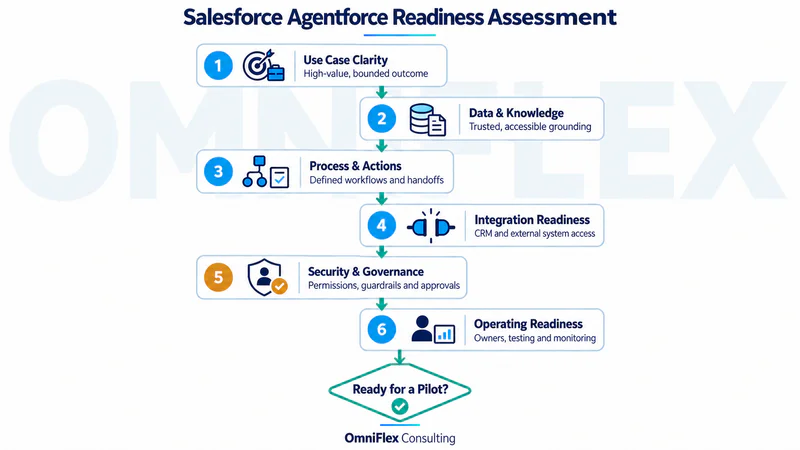
What Is an Agentforce Readiness Assessment?
An Agentforce readiness assessment evaluates whether an organization has the business, data, technology, and operational foundations required to implement a useful AI agent.
It should answer six important questions:
Is the business use case clearly defined?
Is the required data and knowledge available?
Can the agent perform the necessary business actions?
Are security and permissions appropriately designed?
Is there a clear human handoff process?
Can success be measured?
These questions help distinguish an attractive AI demonstration from a solution that can operate reliably in a real business environment.
1. Start With a Clearly Defined Business Use Case
The first readiness checkpoint is business clarity.
A statement such as “We want to implement Agentforce for customer service” is not specific enough to guide architecture or implementation.
What should the agent actually accomplish?
For example, a customer service use case might involve answering order-status questions, retrieving customer information, creating service cases, or initiating an approved business process.
A banking use case might involve helping a Relationship Manager prepare for customer meetings by gathering relationship information, recent activities, open opportunities, and relevant financial context.
Each use case requires different information, actions, permissions, and controls.
Before development begins, the organization should define the intended user, expected outcome, business boundaries, and situations requiring human intervention.
Readiness question: Can we describe the agent's job in one or two sentences without relying on broad AI terminology?
2. Evaluate Data and Knowledge Readiness
AI agents need reliable information to produce useful responses.
For Agentforce, that information may come from Salesforce CRM records, Knowledge articles, Data 360, documents, or external business systems.
However, connecting an agent to more information does not automatically improve its effectiveness.
The information must be relevant, sufficiently current, accessible to the intended user, and appropriate for the use case.
Consider a commercial banking Relationship Manager assistant. Customer relationships may exist in Financial Services Cloud, while loan information resides in a lending platform and other financial information remains in core banking systems.
The readiness assessment should identify which sources are necessary for the first use case and how that information will be accessed.
It should also establish which system is authoritative when information overlaps.
The objective is not to centralize every piece of organizational data before implementing Agentforce. It is to make the required information dependable for the selected agent.
3. Assess Actions and Integration Requirements
An agent that only answers questions is fundamentally different from one that performs business actions.
For example, an agent might retrieve a customer record, summarize a case, create a follow-up task, update an opportunity, or initiate a workflow.
These capabilities may require Salesforce Flow, Apex, APIs, or external integrations.
A readiness assessment should identify the actions required, the systems involved, and the conditions under which those actions are permitted.
It should also distinguish between read-only activities and actions that modify business data.
For an initial Agentforce implementation, we generally recommend starting with a focused set of well-defined actions rather than giving an agent broad access to multiple systems.
This makes testing, security design, and operational monitoring more manageable.
4. Review Security, Permissions, and Governance
Security should be part of the initial Agentforce architecture, not something added immediately before deployment.
Organizations need to consider what information the agent can access, which actions it can execute, and whether those capabilities align with the permissions of the user and the intended business process.
For example, a banking assistant might help a Relationship Manager retrieve customer information, but that does not mean it should independently approve lending decisions or expose restricted financial information.
The readiness assessment should examine authentication, authorization, sensitive-data handling, action boundaries, auditability, and applicable organizational policies.
The goal is controlled autonomy, not unrestricted automation.
5. Define Human Handoff and Exception Handling
Not every interaction should be completed autonomously.
A production-ready Agentforce implementation needs a clear approach for situations where the agent lacks sufficient information, encounters an unexpected condition, or requires human judgment.
For example, a customer service agent may answer standard policy questions but transfer a complex complaint to an employee.
Similarly, a Relationship Manager assistant may prepare recommendations while leaving financial decisions to authorized banking personnel.
Human handoff should be designed around the actual workflow. Employees should receive enough context to continue the interaction without unnecessarily repeating earlier steps.
An effective readiness assessment identifies these boundaries before the agent is deployed.
6. Establish Success Metrics Before Development
One frequently overlooked part of Agentforce readiness is measurement.
Organizations may successfully demonstrate an agent without establishing whether it produces meaningful business value.
Success metrics should relate directly to the selected use case.
Depending on the implementation, these might include time saved, successful task completion, response accuracy, escalation frequency, adoption, or reduction in manual activities.
The measurement framework should also capture failures and exceptions so that the agent can be improved after deployment.
An Agentforce pilot should be treated as the beginning of an operational capability, not simply the completion of a technical demonstration.
What Happens After the Readiness Assessment?
A readiness assessment should produce a practical implementation plan, not another lengthy strategy document.
At Omniflex Consulting, we believe the output should identify the recommended first use case, required data sources, proposed actions, integration dependencies, security considerations, human handoff requirements, and measurable success criteria.
It should also distinguish between issues that must be resolved before development and improvements that can be introduced in later phases.
For organizations with an appropriately scoped use case and suitable technical foundations, an initial Agentforce implementation may be achievable within approximately three to four weeks. Actual delivery depends on integration complexity, data readiness, security requirements, and testing.
The important principle is to start with a useful agent, establish trust, measure outcomes, and expand deliberately.
Final Thoughts
Agentforce readiness is not about achieving perfect data quality or completing every planned Salesforce initiative before adopting AI.It is about determining whether a specific agent has the information, actions, permissions, controls, and operational support required to perform its intended job.Organizations that answer those questions early are better positioned to move beyond demonstrations and build Agentforce solutions that support real business processes.
At Omniflex Consulting, we help organizations assess their Agentforce readiness, identify practical first use cases, and establish a path from initial implementation to production.
Get Practical Salesforce & AI Agent Insights
Actionable insights on Financial Services Cloud and Agentforce delivered to your inbox
Omniflex Consulting
OmniFlex Consulting helps organizations implement Salesforce Financial Services Cloud, Revenue Cloud, Agentforce, and production-ready AI agents.
Visit Site