
Salesforce Agentforce Implementation Cost and Timeline: What to Expect
Author: Omniflex Consulting
Implementing Salesforce Agentforce is not simply about configuring an AI agent and connecting it to a Salesforce environment. A successful implementation requires a clearly defined business use case, reliable data, appropriate integrations, security controls, testing, and an operational plan.
For businesses evaluating Agentforce, two questions typically arise early:
1.How much will Agentforce implementation cost?
2.How long will it take?
The answer depends less on the number of agents being deployed and more on what those agents are expected to accomplish.A focused agent that retrieves Salesforce information and creates follow-up tasks has different implementation requirements from an agent that accesses multiple external systems, executes complex workflows, and handles sensitive customer information.
Understanding these differences is essential when planning an Agentforce investment.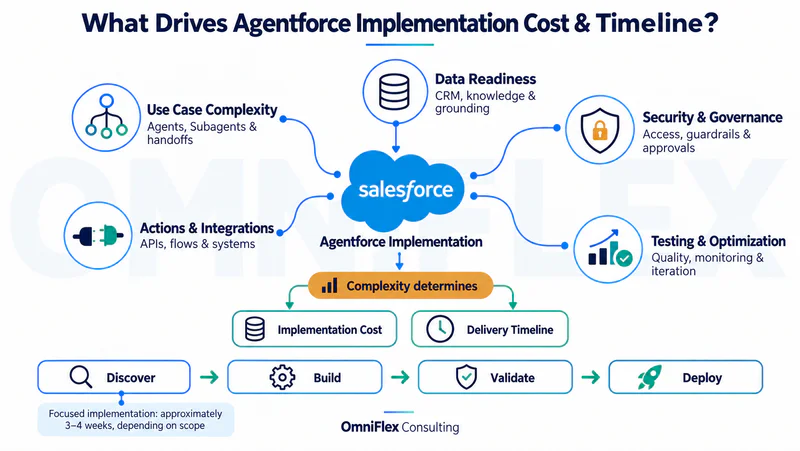
What Determines Salesforce Agentforce Implementation Cost?
There is no universal implementation price for Agentforce. Costs vary depending on the selected use case, existing Salesforce environment, required data sources, business actions, integrations, security requirements, and deployment scope.
A practical estimate should consider six major areas.
1. Business Use Case Complexity
The first cost driver is the problem the agent is expected to solve.
Consider two examples.
An internal sales assistant that summarizes opportunities, retrieves customer information, and creates follow-up tasks may be relatively straightforward when the necessary information already exists in Salesforce.
A customer-facing agent that verifies customer information, retrieves order details from an external ERP system, initiates returns, and escalates exceptions requires a more sophisticated implementation.
Both are Agentforce use cases, but their architecture and delivery effort differ considerably.The best starting point is a specific business outcome rather than a broad requirement to implement AI.
2. Data and Knowledge Readiness
Agentforce needs dependable information to perform its intended responsibilities.That information may come from Salesforce CRM records, Knowledge articles, Data 360, documents, or external business applications.If the required information is already structured, accessible, and reasonably accurate, implementation becomes simpler.
However, if customer information is fragmented across systems, knowledge articles are outdated, or ownership of critical data is unclear, additional preparation may be necessary.An organization does not need to solve every enterprise data problem before adopting Agentforce.It does need to ensure that the information required for the selected use case is reliable.
3. Actions and Integrations
An agent that retrieves information is different from one that executes business processes.For example, an Agentforce implementation may require the agent to create a Salesforce task, update an opportunity, initiate a Flow, invoke Apex, or communicate with an external application through an API.Each additional action introduces implementation and testing considerations.External integrations may also require authentication, error handling, data transformation, monitoring, and coordination with other technical teams.
This is why integration complexity can have a greater influence on project cost than the number of conversational interactions an agent supports.
4. Security and Governance
Agentforce implementations must operate within appropriate organizational controls.The architecture should establish what information the agent can access, which actions it may execute, and when human approval is required.For organizations in financial services, insurance, healthcare, and other regulated environments, these considerations may require additional design and validation.
Security should be addressed during discovery rather than treated as a final deployment activity.
5. Testing and Validation
An Agentforce demonstration may work successfully with a small collection of expected questions.Production environments are different.Users may provide incomplete information, request unsupported actions, or ask questions outside the agent's intended responsibilities.Testing must therefore evaluate more than whether the agent produces a plausible response.It should examine response quality, action execution, permissions, exception handling, escalation, and behavior under unexpected conditions.
A meaningful testing strategy is an important component of the implementation budget.
6. Monitoring and Ongoing Optimization
Agentforce implementation does not end when an agent is deployed.Organizations should monitor usage, successful task completion, failures, escalation patterns, and business outcomes.Instructions, knowledge sources, subagents, and actions may require refinement as business requirements evolve.
This ongoing work should be considered when evaluating the total cost of ownership.
How Long Does an Agentforce Implementation Take?
A focused Agentforce implementation can potentially be delivered within three to four weeks, provided the use case is clearly defined and the required Salesforce capabilities, information, and integrations are available.
At Omniflex Consulting, we approach these projects through a focused implementation model designed to move from discovery to a usable initial release without unnecessary complexity.
A representative delivery approach looks like this:
This is an illustrative schedule, not a guaranteed timeline.
An implementation involving extensive external integrations, complex authorization, poor data quality, or multiple business processes may require additional time.
The key is distinguishing between a focused first release and a broader enterprise Agentforce program.
What About Salesforce Licensing and Usage Costs?
Implementation services and Salesforce product charges are separate components of the overall investment.
Organizations should account for applicable Agentforce licensing or consumption charges, existing Salesforce subscriptions, integration infrastructure, and any additional platform capabilities required by the selected use case.
For example, Data 360 may be relevant when an agent needs access to information distributed across multiple systems. However, not every Agentforce implementation requires a separate enterprise-wide data initiative.
The right architecture should follow the business requirement rather than automatically including every available Salesforce product.Because commercial terms and usage models can change, licensing estimates should be validated against the organization's current Salesforce agreement.
How Can Businesses Control Agentforce Implementation Costs?
One of the most effective approaches is to begin with a narrowly defined, measurable use case.Rather than deploying multiple agents simultaneously, select a business process where the necessary information is available and the expected outcome can be evaluated.
For example, an organization might begin with an internal sales assistant that prepares account summaries and creates follow-up activities.
Once the initial agent demonstrates value, additional capabilities can be introduced.This phased approach allows organizations to validate technical assumptions, understand actual usage, improve governance, and prioritize subsequent investments.It also reduces the risk of building a sophisticated AI solution before establishing whether employees will use it.
How Should You Evaluate an Agentforce Implementation Partner?
Implementation estimates should explain more than the number of development hours.
A prospective partner should be able to describe the business outcome, proposed agent architecture, required data sources, actions, integration dependencies, security approach, testing strategy, deployment responsibilities, and post-launch support.The estimate should also distinguish between capabilities included in the initial release and those planned for later phases.
At Omniflex Consulting, our implementation approach begins with understanding the business process and identifying where Agentforce can create practical value within the existing Salesforce environment.
The objective is to deliver an agent that performs a useful business function, rather than simply demonstrating conversational AI capabilities.
Final Thoughts
Salesforce Agentforce implementation cost and timeline depend primarily on business complexity, data readiness, integrations, security, and the scope of automation.A focused implementation may be achievable within three to four weeks, while more extensive programs require additional planning and delivery effort.For organizations beginning their Agentforce journey, the priority should be establishing one useful, measurable agent with appropriate operational controls.
Once that foundation is in place, additional agents, business actions, and integrations can be introduced based on demonstrated business value.
Get Practical Salesforce & AI Agent Insights
Actionable insights on Financial Services Cloud and Agentforce delivered to your inbox
Omniflex Consulting
OmniFlex Consulting helps organizations implement Salesforce Financial Services Cloud, Revenue Cloud, Agentforce, and production-ready AI agents.
Visit Site