
A Practical Salesforce Financial Services Cloud Implementation Roadmap for Community Banks
Author: Sagarika Sundaramoorthy
Implementing Salesforce Financial Services Cloud (FSC) at a community or regional bank is rarely just a CRM project. Banks already operate with a complex technology landscape that may include a core banking platform, loan origination systems, digital banking applications, document management platforms, marketing tools, and reporting systems. Adding Salesforce to that environment without a clear operating model can simply create another place where employees need to look for information.
A successful FSC implementation should do the opposite. It should make it easier for bankers to understand their customers, manage relationships, identify opportunities, and coordinate work across the bank. That requires thinking about the implementation as a business transformation supported by Salesforce, rather than starting with objects, fields, flows, and features.
For community banks in particular, this distinction is important. Technology teams are typically smaller, budgets receive greater scrutiny, and bankers cannot afford to spend months adapting to a complicated new system. The implementation roadmap therefore needs to deliver useful capabilities early while creating an architecture that can expand over time.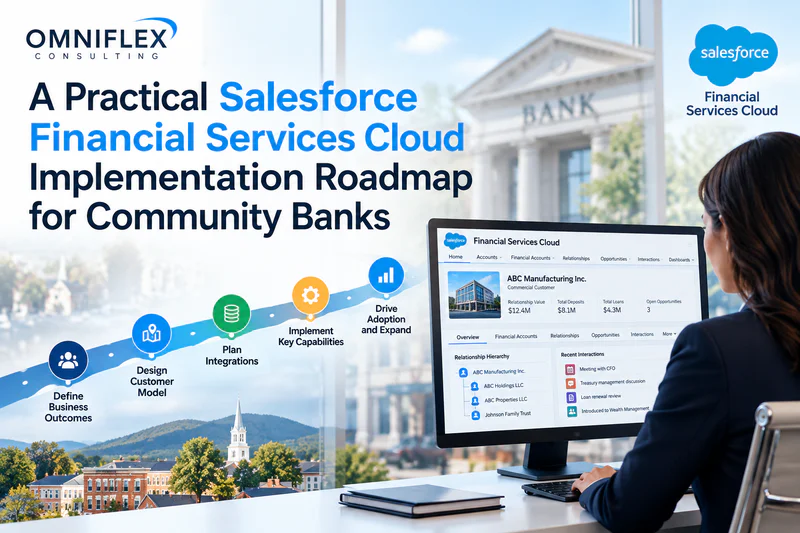
Start With the Banker, Not Salesforce
One of the easiest mistakes to make during an FSC implementation is beginning with the platform. Teams start discussing Accounts, Financial Accounts, households, dashboards, integrations, and automation before agreeing on what should actually improve for the banker.
A better starting point is the daily experience of the people managing customer relationships. Consider a commercial Relationship Manager preparing for a customer meeting. They may need to understand the customer’s deposit relationships, loans, key contacts, recent conversations, open service issues, upcoming maturities, and potential opportunities. If that information requires navigating several systems or asking operations teams for help, there is already a clear business problem to solve.
That gives the FSC implementation a practical objective: create a relationship workspace where the banker can understand the customer and decide what to do next. Once that outcome is clear, Salesforce configuration becomes much easier to prioritize. Features that directly support the experience belong in the initial release, while lower-value requirements can wait.
This also prevents the first release from becoming too large. A bank does not need to transform retail banking, commercial banking, treasury management, customer service, marketing, and lending simultaneously. Establishing a strong foundation for one or two high-value journeys is often a better path.
Build the Customer Model Before Building the Screens
Once the business journey is understood, attention should shift to the customer and relationship model. This is one of the areas where Financial Services Cloud provides considerably more context than a generic CRM implementation.
A commercial banking relationship, for example, is rarely just one company record. A business may have multiple entities, owners, guarantors, executives, deposit accounts, loans, and related households. A banker needs to understand those relationships together, not as disconnected records scattered across the CRM.
This is why the data model should be designed before teams become heavily invested in page layouts and automation. The bank needs clear decisions about how individuals, businesses, households, financial accounts, relationships, referrals, and opportunities will be represented. Where Salesforce provides an appropriate financial-services model, there should be a strong reason before replacing it with custom objects.
The objective is not to recreate the bank's core system inside Salesforce. The core should remain authoritative for the banking information it owns. FSC should organize the customer context required for engagement and make that context useful to the people serving the customer.
That distinction becomes increasingly important as banks begin considering AI. An AI agent can only reason effectively about a customer if the underlying relationships, permissions, and data are understandable and trustworthy.
Treat Integration as Part of the Product Experience
For most banks, the quality of an FSC implementation will eventually depend on what happens outside Salesforce.
A Relationship Manager does not care whether a balance came from Jack Henry, Fiserv, FIS, or another platform. The banker cares that the information is accurate, current enough for the task, and available when needed. From the user's perspective, integration is part of the Salesforce experience.
This is where architecture decisions have long-term consequences. It is tempting to approach integration as a large synchronization exercise and move as much core data as possible into Salesforce. That is not always necessary. Some information may need near-real-time access, other information may only require scheduled updates, and high-volume historical data may be better suited to a data platform than operational CRM storage.
The right question is not simply, “How do we integrate the core with Salesforce?” It is, “What information does this banking process require, how current must it be, and which system should remain responsible for it?”
Making those decisions early reduces unnecessary data movement and creates a cleaner foundation for future capabilities such as Customer 360, Data 360, analytics, and Agentforce. It also makes the architecture easier to operate after the implementation team leaves.
Make the First Release Valuable, Not Comprehensive
Once the business journey, customer model, and integration architecture are clear, the first production release should be deliberately focused.
For a bank centered on commercial relationships, that release might give Relationship Managers a consolidated customer view, financial-account visibility, relationship hierarchies, interaction tracking, referrals, opportunity management, follow-up activities, and management dashboards. Those capabilities together can create a meaningful change in how bankers manage their portfolios without attempting to replace every process at once.
This is also the point where implementation teams need discipline around customization. Banks naturally bring years of existing processes, reports, fields, and approval steps into discovery sessions. Some are necessary because of regulatory or operational requirements. Others exist primarily because an older system forced users to work that way.
Recreating every legacy process inside Salesforce may produce a familiar system, but it can also eliminate much of the value of moving to a new platform. Each customization should therefore answer a simple question: what business or compliance outcome requires this to work differently from the standard platform?
That question tends to produce a much healthier backlog.
Go-Live Is Where the Roadmap Really Begins
A bank can deliver a technically excellent Salesforce implementation and still struggle if Relationship Managers do not see a reason to use it every day.
Adoption works better when Salesforce becomes part of how bankers accomplish real work. Training a Relationship Manager to “create an Opportunity” is far less meaningful than showing how Salesforce can help prepare for an upcoming customer meeting, identify a potential treasury need, involve the right specialist, document the conversation, and make sure the follow-up actually happens.
The same principle should influence how success is measured. Login counts alone say very little about whether the implementation is improving the business. Banks should look at indicators such as relationship activities captured, referrals generated, opportunities created, customer data completeness, meeting preparation time, onboarding progress, or whatever outcomes justified the project in the first place.
Those measurements also help determine what comes next. A successful first release may lead into additional lines of business, more sophisticated Customer 360 capabilities, improved onboarding, marketing integration, Data 360, or Agentforce use cases. The roadmap becomes an iterative investment rather than a one-time technology deployment.
That is especially important with AI becoming part of the Salesforce roadmap. Banks understandably want to explore agents that can prepare Relationship Managers for meetings, summarize customer relationships, recommend next actions, or automate follow-up work. Those capabilities become considerably more valuable when they sit on top of well-designed customer data, reliable integrations, clear permissions, and established business processes.
A Practical Roadmap Starts Smaller Than Most Banks Expect
The strongest FSC programs do not necessarily begin with the largest scope. They begin with a clearly defined banking problem and create enough architecture to solve that problem without limiting what comes next.
For a community bank, that might mean starting with commercial Relationship Managers and creating a reliable customer and relationship view. Once bankers trust the information and Salesforce becomes part of their daily workflow, the bank can expand into additional processes and capabilities with much greater confidence.
This approach also changes the implementation conversation. Instead of asking, “How much of Financial Services Cloud can we deploy?” the bank can ask, “What should become measurably better for our customers and bankers in the next six months?”
That is a much more useful question.
At Omniflex Consulting, we believe a Financial Services Cloud roadmap should connect business outcomes, banking processes, data, integration, and architecture before implementation scope is finalized. For banks evaluating FSC, a focused roadmap workshop can often identify the right first use case, expose integration dependencies early, and provide a realistic path from the initial implementation to broader customer engagement and AI capabilities.
Get Practical Salesforce & AI Agent Insights
Actionable insights on Financial Services Cloud and Agentforce delivered to your inbox
Omniflex Consulting
OmniFlex Consulting helps organizations implement Salesforce Financial Services Cloud, Revenue Cloud, Agentforce, and production-ready AI agents.
Visit Site