
How to Choose the Right First Agentforce Use Case
Author: Sagarika Sundaramoorthy
Interest in Agentforce often starts with a simple question: what can we automate with an AI agent?
It is an understandable place to begin, but it is usually not the best question for choosing a first implementation. Agentforce can support a growing range of use cases across sales, service, financial services, employee workflows, and other areas of the business. That flexibility can make the first decision surprisingly difficult. When almost every process appears to be a candidate for an agent, organizations can easily choose something impressive for a demonstration but difficult to turn into measurable business value.
A better starting point is to ask where employees or customers repeatedly spend time gathering information, making predictable decisions, or completing a series of actions that could be assisted by an agent. The first Agentforce use case should sit at the intersection of meaningful business value, accessible data, clearly defined actions, and manageable risk.
That sounds straightforward. In practice, getting those four things aligned is often more important than the sophistication of the agent itself.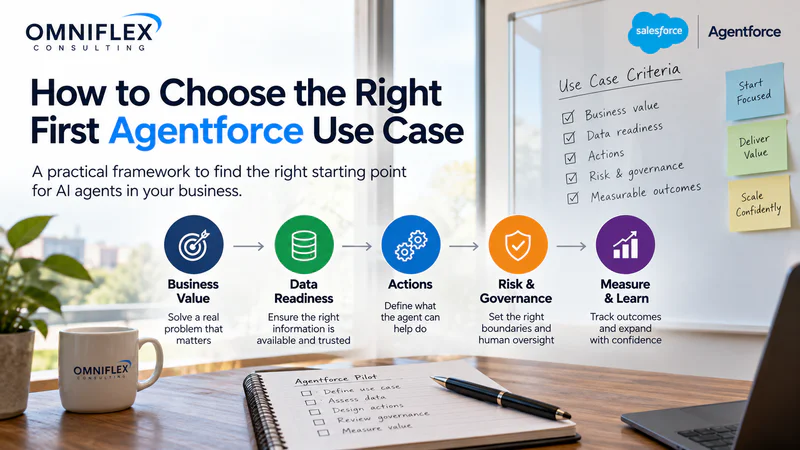
Start With the Business Friction
A good Agentforce use case usually begins with a process problem rather than an AI idea.
Consider a Relationship Manager at a bank preparing for a customer meeting. Before the meeting, the banker may review accounts, opportunities, previous interactions, service issues, upcoming maturities, and notes from several systems. The task is repetitive, but it also requires understanding the context of the relationship.
An Agentforce use case could bring that information together and prepare a meeting brief. The agent might summarize the relationship, identify outstanding items, highlight recent activity, and suggest areas the Relationship Manager may want to discuss. The banker remains responsible for the conversation and the decisions, while the agent reduces the preparation work required to get there.
Compare that with starting from a statement such as, “We want an AI agent that can help our bankers.” The second idea sounds ambitious, but it does not define the problem, the required information, the actions the agent can perform, or how success will be measured.
The more precisely the business friction is defined, the easier the Agentforce architecture becomes.
The Best First Use Case Is Rarely the Most Ambitious One
Organizations understandably want their first AI project to demonstrate something significant. That can lead teams toward highly autonomous use cases involving many systems, complex decisions, and customer-facing actions.
Those projects may eventually create substantial value, but they also introduce more variables at exactly the point where the organization is still learning how agents behave in its environment.
A first implementation should allow the organization to learn how Agentforce interacts with enterprise data, instructions, actions, permissions, and employees without placing unnecessary risk on the business. An internal or employee-assisted workflow is often a good candidate because the agent can create value while a person remains in control of the final decision.
This does not mean the first use case should be trivial. An agent that answers a handful of questions from static documentation may be easy to implement, but it may not demonstrate enough value to justify broader investment. The goal is to find the middle ground: useful enough that employees notice the difference, but bounded enough that the organization can understand and manage the behavior.
That balance becomes especially important in regulated industries such as banking, insurance, and wealth management. The first project should build confidence in the operating model rather than force the organization to solve every AI governance problem at once.
Data Readiness Can Change the Entire Decision
A use case may look excellent on a whiteboard and still be a poor first Agentforce project if the underlying information is fragmented, inconsistent, inaccessible, or poorly governed.
Take the Relationship Manager example. Creating a useful meeting brief requires the agent to understand the customer, related contacts, financial relationships, previous interactions, open opportunities, and potentially information coming from core banking or other systems. If Salesforce contains only part of that picture, the agent may produce a technically correct response based on incomplete context.
This is why Agentforce readiness and data readiness are closely connected.
Before selecting a use case, organizations should understand where the required information resides, whether Salesforce can access it, how current it needs to be, and which source should be considered authoritative. Some use cases can operate effectively using CRM data already available in Salesforce. Others may require integration, Data 360, knowledge sources, or changes to the underlying data model before the agent becomes genuinely useful.
The first use case does not need perfect enterprise data. It does need sufficiently reliable context for the task the agent is being asked to perform.
This is also one reason narrowly defined use cases often succeed earlier. They reduce the amount of enterprise context that must be solved before value can be demonstrated.
Think About Actions, Not Just Answers
Many early AI initiatives focus on the quality of generated responses. For Agentforce, that is only part of the value.
An enterprise agent becomes considerably more useful when it can help move work forward. Depending on the use case and permissions, that might mean creating a follow-up task, updating information, initiating a workflow, preparing a communication, retrieving account details, creating a case, or invoking an existing Salesforce automation.
That changes how a use case should be evaluated.
Imagine an agent that prepares a Relationship Manager for a meeting. Summarizing the relationship is useful. But after the meeting, the same experience could eventually help summarize notes, identify follow-up items, create tasks, update an opportunity, or prepare a draft communication for the banker to review.
The important word is eventually.
The first release does not need every possible action. In fact, allowing the agent to recommend an action before giving it permission to execute that action can be a sensible progression. Organizations can increase autonomy as they understand accuracy, exceptions, permissions, and user behavior.
Agent design should therefore consider both what the agent needs to know and what it should be allowed to do.
Risk Should Shape the Architecture
Every Agentforce use case carries some form of risk, but the type and consequence vary considerably.
An incorrect internal meeting summary that a Relationship Manager reviews before use has a different risk profile from an agent autonomously communicating financial information to a customer. Similarly, recommending a next step is different from executing a transaction or changing sensitive customer data.
The architecture should reflect those differences.
Human review is not simply a temporary limitation while an organization becomes comfortable with AI. In many business processes, human involvement is part of the appropriate long-term design. The objective is not necessarily to remove people from every workflow. It is to determine where the agent can perform repetitive work, where it can assist a decision, and where accountability should remain with a person.
Permissions deserve the same attention. An agent should not gain broader access simply because AI is involved. Its ability to retrieve information and perform actions should follow the organization's security model and the business context of the user interacting with it.
A well-chosen first use case makes these boundaries relatively easy to define.
Measure Whether the Agent Changed the Process
One of the weakest ways to evaluate an Agentforce pilot is to ask whether users thought the demo was impressive.
The more important question is whether the agent changed the economics or experience of the process.
For the Relationship Manager example, the organization might look at the time required to prepare for a meeting, completeness of customer context, follow-up activities captured, opportunities identified, or adoption among bankers. A service use case might instead measure resolution time, repetitive work eliminated, escalation rates, or the percentage of interactions successfully completed with agent assistance.
The metric should connect directly to the business friction that justified the use case.
This becomes important when moving from pilot to production. A demonstration proves that an agent can perform a task under controlled conditions. A production implementation needs to demonstrate that the capability creates enough consistent value to justify operating, governing, and expanding it.
Organizations that establish those measures during use-case selection are in a much better position to make that decision objectively.
Your First Agent Should Teach You What to Build Next
The first Agentforce implementation should not be treated as an isolated experiment. It should establish patterns the organization can reuse.
A successful project teaches the team how to provide context to an agent, design instructions, expose actions safely, manage permissions, test responses, handle exceptions, involve humans, monitor behavior, and measure outcomes. Those lessons become part of the architecture for subsequent agents.
This is why choosing the right first use case matters more than choosing the most exciting one.
For many organizations, the strongest starting point is a bounded workflow where employees already spend meaningful time collecting information or completing repeatable work, the required data is reasonably accessible, the agent's actions can be controlled, and the result can be measured.
Once that foundation works, the organization can expand the agent's responsibilities or move into more complex use cases with significantly more confidence.
At Omniflex Consulting, we approach Agentforce use-case selection as an architecture and business-value decision rather than a brainstorming exercise. Before building an agent, we look at the process being improved, the data required to support it, the actions the agent needs to perform, the risks involved, and the outcome the organization expects to measure.
The question is therefore not simply, “Where can we use Agentforce?”
A much more useful question is:
“Where can an agent create measurable value today while establishing the foundation for what we want to automate tomorrow?”
That is usually where the right first Agentforce use case begins.
Get Practical Salesforce & AI Agent Insights
Actionable insights on Financial Services Cloud and Agentforce delivered to your inbox
Omniflex Consulting
OmniFlex Consulting helps organizations implement Salesforce Financial Services Cloud, Revenue Cloud, Agentforce, and production-ready AI agents.
Visit Site