
From Agentforce Pilot to Production: A Practical Implementation Roadmap
By Omniflex Consulting
Building an Agentforce pilot is relatively straightforward when the business use case is focused, the required information is available, and the agent operates within a controlled environment. Moving that same agent into production, however, introduces a different set of challenges. Real users bring unexpected questions, incomplete information, integration failures, security considerations, and operational requirements that may not have surfaced during the initial demonstration.
A pilot may successfully retrieve Salesforce records, answer predefined questions, or execute a limited number of business actions. However, these capabilities alone do not establish whether the solution is ready for everyday business use. Organizations must also consider reliability, governance, exception handling, and the ability to monitor agent performance after deployment.
The difference between an Agentforce pilot and a production deployment is not simply additional development. It is the ability to operate reliably within real business processes.
At Omniflex Consulting, we approach this transition through a structured implementation roadmap that addresses both the technical and operational requirements of deploying AI agents.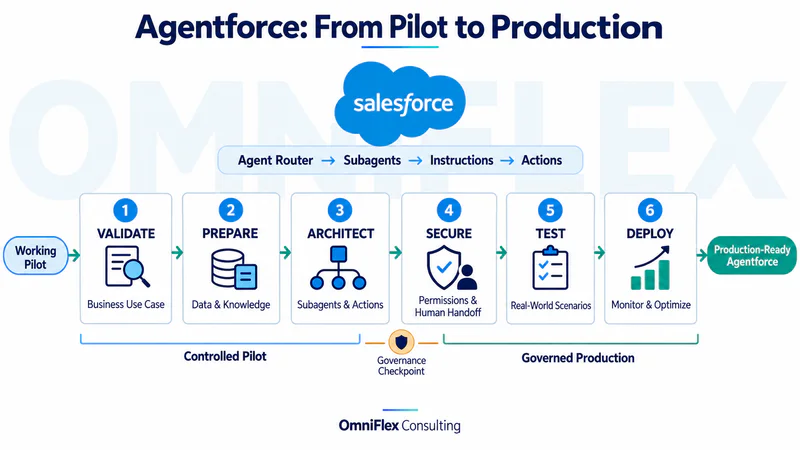
Why Agentforce Pilots Struggle to Reach Production
An Agentforce pilot is generally designed to validate technical feasibility. For example, a sales assistant might retrieve account information, summarize an opportunity, and create follow-up activities. Similarly, a customer service agent might answer policy questions using Salesforce Knowledge and initiate predefined workflows. These demonstrations can establish whether Agentforce is suitable for the selected use case, but they rarely expose every condition the agent will encounter in production.
Challenges typically emerge when organizations begin expanding beyond the controlled pilot environment. Data that worked well during demonstrations may be incomplete or outdated. Business actions may not account for unexpected inputs, security permissions may be too broad, and human escalation procedures may remain undefined. Integrations that function reliably during testing may also encounter failures when interacting with live business systems.
Addressing these gaps requires more than adjusting agent instructions. It requires a deliberate production-readiness process that evaluates the entire solution.
Stage 1: Validate the Business Use Case
Before expanding an Agentforce pilot, organizations should revisit the business objective that justified the initial investment. What problem was the agent designed to solve, who will use it, and which measurable business outcome should improve? These questions help establish whether the pilot is ready to become an operational capability or whether its scope requires further refinement.
Consider an Agentforce assistant designed for commercial banking Relationship Managers. The agent might prepare customer meeting summaries by gathering information from Salesforce Financial Services Cloud, reviewing recent activities, identifying open opportunities, and presenting relevant relationship context. The intended business outcome could be reducing manual meeting preparation while improving access to customer information.
This objective is more useful than simply measuring whether the agent can generate a summary. The implementation team should also identify activities that remain outside the agent's responsibilities, particularly those requiring professional judgment, additional authorization, or human approval.
Stage 2: Establish Reliable Data and Knowledge
A pilot may perform well using a carefully selected collection of Salesforce records or Knowledge articles. Production environments require greater confidence in the accuracy, completeness, and freshness of the information supporting the agent. Organizations should therefore evaluate the data sources required for the use case and establish how that information will be accessed.
Depending on the architecture, an Agentforce implementation may retrieve information from Salesforce CRM, Knowledge, Data 360, or external business applications. This does not mean every enterprise system must be integrated before the first production deployment. Instead, the focus should remain on making the information required for the selected use case dependable and accessible.
Data ownership is equally important. When information exists across multiple systems, the implementation must establish which source is authoritative. An AI agent cannot consistently deliver reliable outcomes when the underlying business information is contradictory or outdated.
Stage 3: Strengthen Agent Architecture and Actions
As an Agentforce pilot evolves, its architecture should be reviewed for maintainability, scalability, and operational control. Agentforce uses an Agent Router to direct interactions to appropriate subagents, with instructions and actions defining their responsibilities. A production implementation should establish clear boundaries between these capabilities rather than allowing the agent to perform loosely defined tasks across multiple business processes.
Actions executed through Salesforce Flow, Apex, APIs, or external integrations require particular attention. An agent that creates a follow-up task introduces different operational considerations from one that updates financial information or initiates a transaction in another system. As the consequences of an action increase, authorization, validation, error handling, and human involvement become increasingly important.
The objective should be predictable agent behavior supported by a maintainable architecture, not unnecessary technical complexity.
Stage 4: Implement Security and Human Handoff
Security cannot remain at demonstration-level configuration when Agentforce enters production. The implementation should evaluate user permissions, data visibility, authentication, sensitive-information handling, action authorization, and applicable organizational policies. These considerations become particularly important when an agent interacts with financial information, customer records, or business processes that have operational consequences.
Organizations must also define when an agent should transfer responsibility to an employee. For example, a customer-facing agent may independently answer routine questions but escalate complex complaints, sensitive requests, or unsupported transactions. Similarly, an internal banking assistant may prepare recommendations while leaving lending decisions to authorized personnel. A well-designed handoff should preserve the relevant conversation and business context so employees can continue the process without unnecessary repetition.
The objective is not to maximize autonomy at every opportunity. It is to establish the appropriate level of autonomy for each business process.
Stage 5: Test Beyond Expected Conversations
A production-ready Agentforce implementation requires more than testing whether the agent responds correctly to a collection of predefined questions. Organizations should evaluate how it behaves when users provide incomplete information, ask unexpected questions, request unauthorized actions, or encounter unavailable systems. Testing should cover response quality, action execution, permission boundaries, escalation behavior, integration failures, and recovery from unsuccessful operations.
Business users should participate in acceptance testing using realistic scenarios rather than relying exclusively on technical teams. Their involvement helps identify gaps that may not be apparent during development, particularly when the agent supports complex business workflows. The testing process should also verify that the agent does not perform actions outside its intended responsibilities.
Stage 6: Deploy, Monitor, and Optimize
Production deployment marks the beginning of an operational lifecycle rather than the completion of an Agentforce project. Once an agent becomes available to users, organizations should monitor whether it performs its intended responsibilities successfully and consistently. Relevant measurements may include task completion, escalation frequency, response quality, adoption, execution failures, and time saved.
These measurements should connect directly to the original business objective. Monitoring also helps identify situations where agent instructions, subagents, actions, knowledge sources, or integrations require refinement. A controlled deployment to a smaller user group can provide valuable operational feedback before expanding adoption across the organization.
Agentforce should therefore be treated as a continuously managed business capability rather than a one-time configuration exercise.
How Long Does It Take to Move an Agentforce Pilot Into Production?
The timeline depends on how much of the production foundation already exists. A focused pilot supported by reliable data, clearly defined actions, limited integrations, and appropriate security controls may require relatively modest additional work. However, a pilot relying on temporary integrations, broad permissions, manually prepared information, or incomplete testing may require significant architectural changes before production deployment.
For a new, tightly scoped Agentforce implementation, Omniflex typically positions an initial delivery window of approximately three to four weeks, subject to readiness and complexity. An existing pilot should be assessed individually rather than assigned a universal production timeline. A practical starting point is a gap assessment that identifies which capabilities can be retained, which require modification, and what belongs in the first production release.
Final Thoughts
Moving Agentforce from pilot to production requires a shift in priorities. During a pilot, the primary question is whether the technology can perform the intended task. In production, the question becomes whether the agent can perform that task reliably, securely, and consistently within real business operations.
A structured roadmap covering business objectives, data readiness, architecture, security, testing, deployment, and monitoring provides a practical foundation for that transition. At Omniflex Consulting, we help organizations move beyond Agentforce demonstrations and build AI agents designed to support measurable business outcomes.
Get Practical Salesforce & AI Agent Insights
Actionable insights on Financial Services Cloud and Agentforce delivered to your inbox
Omniflex Consulting
OmniFlex Consulting helps organizations implement Salesforce Financial Services Cloud, Revenue Cloud, Agentforce, and production-ready AI agents.
Visit Site